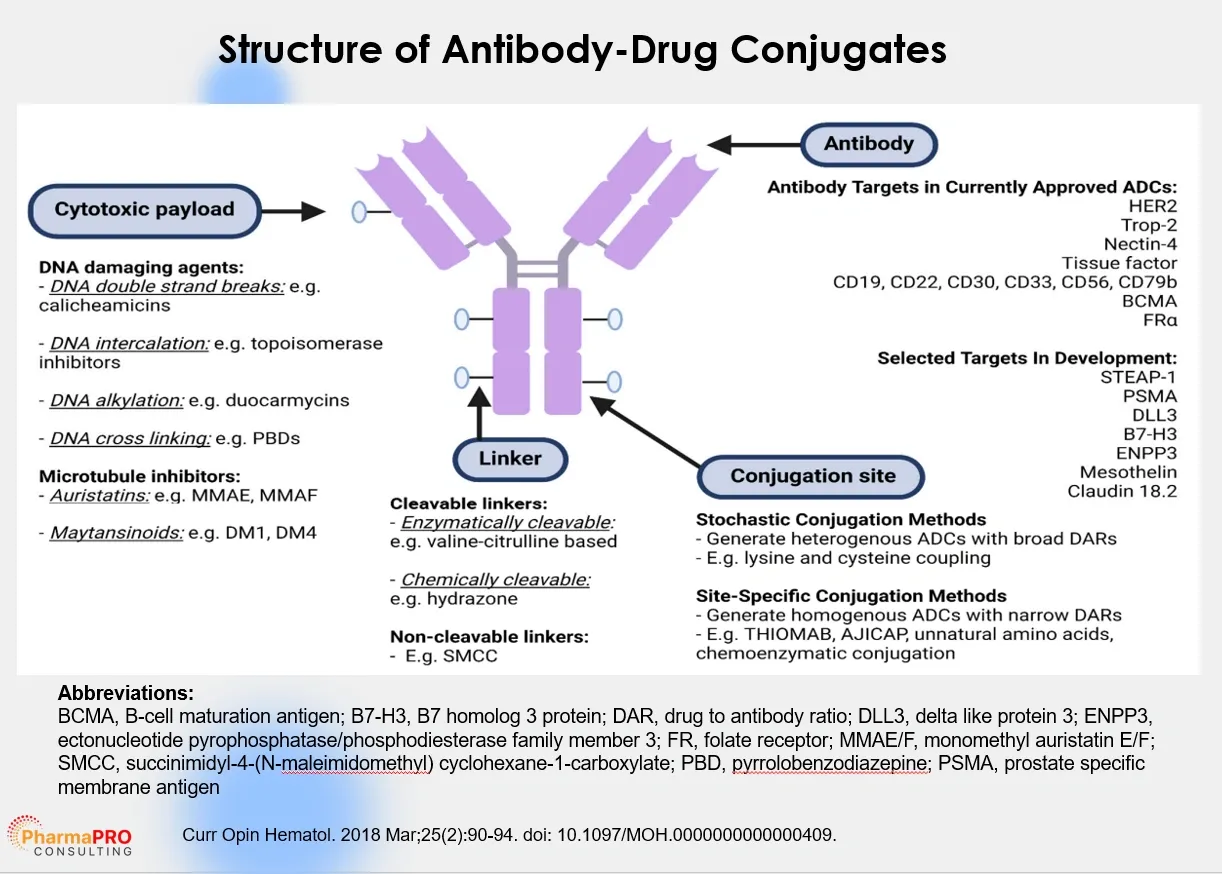
The future of Antibody-Drug Conjugates (ADCs) in drug development is promising and dynamic, with numerous exciting prospects on the horizon. Over 100 ADCs are currently under preclinical and early-stage clinical research, highlighting the significant investment in advancing this therapeutic class. Researchers are shifting their focus from targeting oncogenic driver mutations to exploring antigens that are preferentially over-expressed in malignant cells, allowing ADCs to effectively target a broader range of cancers.
New antigenic targets being explored, in solid tumors include prostate-specific membrane antigen (PSMA), a six-transmembrane epithelial antigen of prostate-1 (STEAP-1), tissue factor, delta-like protein 3 (DLL-3), mesothelin, ENPP3 and B7-H3 family of proteins, expanding the potential applications of ADC therapy. Additionally, bispecific ADCs that target two different antigens or different sites on the same antigen are being studied to enhance ADC internalization and anti-tumor activity.
Innovative payload structures, including dual payloads and tyrosine kinase inhibitors, are being explored to improve efficacy in tumors with heterogeneous target expression. Furthermore, ADCs are being combined with immunotherapy approaches to stimulate the immune system and enhance the anti-tumor effect. Immune-stimulating ADCs containing STING agonists and TLR agonists are also in development to directly activate the immune response.
While significant progress has been made, challenges remain, such as understanding resistance mechanisms, optimizing dosing strategies, and exploring the complex interplay between ADCs and the immune system. Nonetheless, ongoing research and clinical trials offer tremendous opportunities to improve ADC therapy, making it a promising avenue for future cancer treatment and potentially transforming patient outcomes.
References:
CA Cancer J Clin. 2022 Mar;72(2):165-182. doi: 10.3322/caac.21705. Epub 2021 Nov 12.
Molecules. 2021 May 15;26(10):2943. doi: 10.3390/molecules26102943.
Molecules. 2020 Oct 16;25(20):4764. doi: 10.3390/molecules25204764.
Curr Opin Hematol. 2018 Mar;25(2):90-94. doi: 10.1097/MOH.0000000000000409.

Leave a Reply